Hello to all my current readers and subscribers. I have recently migrated my content to a new platform. All new content will be posted there. If you’d like to continue to read my posts, please check out my new site Miriam-Lein@ghost.io For those who like to receive email notifications of my new posts, you will need to resubscribe on the new site.
If you are wondering why I have refreshed things, go on over and read the post I just posted today. I would love to also hear from each of you on what themes you particularly like to read from me, so that I can tailor my content as well.
It’s raining again as it has off and on for the last few days and many other days for this entire month. A wind ruffles the new leaves of the apple tree outside my living room window. Pink and white flower buds cover the tree, a few tentatively opening their petals despite the lack of sunlight and warmth the last few weeks. After finally giving up on trying to climb in my lap and displace my iPad and keyboard, Bede has managed to squeeze himself onto the little bit of remaining footstool so that he can sleep curled up against my feet.
In this perfectly peaceful and idealic setting, I am grappling with the limits of time. I am not old, but I am getting older, and as different things in my body begin to show signs of age and wear, I have taken stock of what I want to be doing with my time and how I’m not doing it yet. I want to be an artist. No, I AM an artist. But I am an artist who is currently producing very little art. I envision a future full of writing, sewing, sketching, printing. For years I’ve dreamed of creating a space where not only can I be doing those things, but I can invite others in to do those things as well. A place full of deep conversation, meaningful creativity, and energetic community. But I’ve only ever taken the very first few steps towards that goal before life circumstances seem to get in the way.
I spend a lot of time these days frustrated with both the circumstances of my life that leave me with very little resources of time, energy, or money to use towards my larger goals and with myself for not using what little bit I do have in a way that would indicate that I actually value art and creativity. Creativity for me seems to take quite a bit of tenacity and intentionality. It does not happen spontaneously in the in-between spaces of my busy days no matter how much I might expect it to.
It was Springtime when I started this blog as you can tell from the intro. As I sat pondering all this and attempting to reflect it all in writing, John came home and we ended up discussing all of this. We are both in similar mental spaces, grateful for so much of what our current life offers us and yet still desiring to live more fully into the artistic life. While our discussion didn’t immediately answer all of our questions, it did lead to identifying one simple step we can take towards an intentional plan to use what little resources we do have (including using my PTO very intentionally) to try to coordinate more of our free hours so that we can together devote time
for creativity and community building. Knowing that summer is crazy we set our plan to start in September once everyone was back at school. That time is now almost upon us. As I go through this incredibly busy couple of weeks moving boys out of the house and into dorms (Seth back to boarding school, Will to college), seeing Dietrich off to his first day of 7th grade, and planning and carrying out professional development days for the staff at work; I am also counting down the days to the first of these intentional afternoons we’ve set aside devoted to creativity. I know it isn’t much, but it is something that I’ve clung to, determined to keep this promise to myself. Even though I cannot yet see the path to the future I envision, I can see this one intentional step I can take to bring at least a little bit of that future into my present.
Anniversaries are somewhat meaningless in measuring wisdom. We cannot expect someone to have the answers to healthy relationships just because they have been married a long time. And though I don’t think it is wrong to recognize and celebrate certain milestones, I also feel strongly that longevity is not necessarily an indicator of relationship success. So, take that as you will, and read on with a critical eye.
People change over time, which means that their relationships necessarily do as well. The two 20 year olds who stood in Siloam Springs Bible Church 25 years ago and said “I do,” are not the same people as the two 45 year olds who are living life together now. Over the years we have both been many different versions of ourselves in many different versions of relationship. Our relationship has sometimes been an assumption, barely there as we learned to survive as adults and parents. Other times, it has been weighty for me, a responsibility that felt hard, an expectation that I could never ever live up to. Then there were times of discovery, a freedom found in learning to think about ourselves and each other without the burden of the expectations of our former selves. And there were times of anguish and questioning, wondering if this relationship was still worth the effort it took. Other times, and I think this is one of them, our relationship has been comfortable, not as exciting as some of those other times perhaps, but also not nearly as difficult. I’ve been pondering this lately, and wondering if it is healthier to live in continual gratitude for each stage you’ve been able to experience, or if we should be constantly striving to return to some previous rendition of our relationship. A friend recently pointed out that just because I’ve left fulfilling seasons in the past, doesn’t mean that there are not new and wonderful times ahead. This struck me as very wise. I would like to adopt this attitude, allowing myself to be grateful for what was and what is, while also working towards health and wholeness with a patient and open expectancy of what will be.
Choice is an essential and always present piece of every relationship. You, like I, may have been led to believe differently. At the time I made vows to my husband, I truly thought this was a one and done decision I was making. In some ways that brought me peace as it removed a certain amount of anxious questioning that I was often prone to. But I have come to believe that this concept of the once and forever decision is just not true. We always have a choice. Every day we get to decide if we are present in this relationship or not. As we grow and change and our partner grows and changes, I believe it is a healthy and necessary thing to recognize our own agency in the continuance of the relationship. I was raised in a religious and cultural context that made very little room for the choice to leave a relationship after wedding vows were said. Divorce was really only justified on the grounds of infidelity or abuse, which meant that it was always negative and was most definitely a failure. I was taught that I shouldn’t even consider it an option because that would cause me to not be fully committed to the relationship. I have now realized that it is the existence of continual choice that actually frees me to fully and truly commit. Recognizing and exercising choice can be a scary thing. I have walked the dark and fearful path of truly questioning whether or not I wanted to continue this journey with this partner, and it was not an easy place to find myself. Ironically, what rescued me from those moments of internal angst was the recognition that not only could I choose to leave, but I could also choose to stay, which I realized was exactly what I wanted to do. Again, not a once and forever choice, just a choice for that moment, that day, that month, that year, and on and on and on.
Choice goes both ways. Maybe this is obvious, but in case it is not, let me extrapolate. It is not just that I have agency to choose, but so does my partner. This means I must give him the space to do so. I believe that true love does not cling, but rather holds loosely, allowing the other person to choose how present they are at any given time, and ultimately whether or not they want to stay. It doesn’t mean I can’t bring up concerns or ask for things, but I must always respect the other’s individuality within the relationship. If I had learned this earlier in my relationship I think it would have saved me from a lot of unrealistic expectations and disappointments and allowed me to focus more on learning who my husband actually was, rather than who he was expected to be.
Personal growth enriches rather than detracts from our relationships. I was raised in a patriarchal context surrounded by subtle and sometimes not so subtle messages that my husband’s goals and priorities should be my own. Example: I read an organization book written for wives and mothers who were managing large households that told me to let my husband set our family’s priorities and to set aside time in my day to work towards his goals. It took some time for me to completely separate from this cultural expectation and realize that it is my own goals and priorities that I should make central to my day. And while I think this is a worthwhile endeavor in and of itself because I believe I am worth my own time and effort, I also think that my relationships thrive when I am actively working towards becoming who I want to be in this world.
At the end of last winter, I remember going for a walk during the season of Lent, down one of the rural roads near where we live. I walked through the forest—overgrown and tumbling cabin walls marking the remains of long abandoned homesteads. It was bitter cold, and everything was still brown and grey and still. The quiet seemed to be embodied by the trees, who stood as strong grounded sentinels, only their very tops giving in with the slightest movement to the wind. And yet, despite the stillness of the forest, it was as if I could feel the vibration of unseen life below the surface. It was quiet, but not dead. Still, but not inactive. Life coursed through the forest as it readied itself for Spring.
At the time, I was dealing with a very stressful job. There was so much upheaval that felt very much out of my control in my work. I was drawn in that moment to those trees. Though I could feel the cold wind on my face, I could not see it in the trees without looking up to the topmost branches. They felt grounded and strong and yet very much alive. That was the spirit I wanted to strive for in the chaos of that moment. Not numbness, but rather peace. Not inactivity, but rather quiet internal work, the work that would make a true difference as the world around me changed.
And it dawned on me that this is what the season of Lent can be as well. It is waiting, but also working. Preparing ourselves for the next stage or season, whatever that may look like personally in our lives.
As I contemplate the memory of my intention, I can’t help but reflect on the results of it over the course of that year. I’ve come full circle now, back to another Lent. Was I successful at embodying the quiet dignity of a tree? Some days I think I was. But other days the chaos left me windswept and worried. The stressors in my work ebbed and flowed. Sometimes it felt like things were settling down and then we’d be thrown into a new catastrophe. There were tears and tension and dismay and hopelessness throughout those months. There was also hope and joy and community and wisdom. Sometimes I experienced all of those things in one day. But it wore on me. Eventually I did what the tree cannot do, I picked up my roots and moved away from the chaos. I opened myself up to new opportunities and accepted a new position in a different organization.
I am proud of myself for taking that risk, for prioritizing my mental, physical, and emotional health. Stability is what I felt I had to cling to last year, standing firm in the midst of the chaos. I felt so beaten down over the last year, and there are so many rhythms I created to cope with stress that I’d like to now dismantle. I wanted to write that my intention this year is to focus on growth, because there are so many things I want to grow more into, things that I set aside over the last year due to lack of energy—writing, art, sewing. But then I remembered that the lack of these things in my life over the last year does not automatically equate to a lack of growth. In the last few weeks of the job I left, I did a lot of reflecting on my time there. And I realized that one thing that had happened was that I had grown. I had grown in confidence and ability and even in ambition. It was hard fought and sometimes uncomfortable growth, as growth often is. So perhaps, growth is not quite the word I’m looking for. Perhaps expansion and energy are more fitting. Like a tree in Springtime, when the flowers and leaves burst forth in an outward expression of all that inward preparation, I now want to focus on the outward expressions of my strength and resilience. It is fitting therefore, to post here on this blog which has remained quiet for far too long. May this be the first of many posts this year.
Two weeks ago, I drove 15 minutes to a nearby CVS to get my COVID booster and my flu vaccine. This is only the third time that I’ve gotten a flu shot. The first time was in 2005. That was the year I gave birth to Emma Anne. Because of her compromised immune system and her open heart surgery and continued fragile health status, we asked everyone in our immediate family to get a flu shot to protect her from getting the flu until she was old enough to get her own flu vaccine.
I also made sure Emma had all her vaccinations that she was eligible for before her surgery. This was actually a requirement by the children’s hospital for her own protection, but there were people who questioned my decision to inject her body with vaccines when she was already so weak. My reasoning was simple though. I knew that because of her fragile health, any respiratory illness was likely to kill her, and the most effective way to protect her was to give her immunizations.
Once Emma was 6 months old, she was eligible for a flu vaccine, and I did get her one, mere days before she ended up catching it anyway (likely exposed before the vaccine was in her system). Five days later she passed away. While I don’t know for certain that the flu was the cause of death, I’m pretty certain that the damage it did to her system contributed to the complication of factors that led to her passing.
After that year I didn’t get the flu shot again until 2021. There wasn’t anyone immunocompromised in my immediate circle. I, personally, had only ever gotten the flu once, maybe twice in my life and while it wasn’t fun, it wasn’t particularly worrying to my health. And there were all these messages I was picking up from people around me, anti-vaxers and vaccine hesitant friends. It made me hesitant to get a vaccine I couldn’t convince myself that I personally needed. Why inject myself with something I’m not completely sure of the risks of when my risk of getting seriously ill are quite low? That was my reasoning. And that remained my reasoning until 2020.
I’m sure you can probably guess where I’m going with this. In 2020 we were hit with the corona virus and suddenly there was a lot more increased awareness of “public health.” In American culture I believe our natural instinct is to think of issues in an individual sense. We are used to making decisions, especially medical ones, based on how we are individually affected. What’s my personal risk and what actions should I take to manage that effectively? For many health issues, this is the correct way to go about it. My body, my choice, and all that. I totally get that. But, in cases of infectious disease, the risk is never just individual. When I get sick, I’m at risk of infecting others, so now their individual risks need to be taken into account too.
I’m not sure why thinking about risk in this way doesn’t come naturally to us. If we live with an immunocompromised person, like I did with Emma 16 years ago, then we might learn to at least take that one other person into account. But it’s a really heavy thing when we stop to think about the web of people we are connected to outside of our household, and perhaps that is why we don’t think about it. In fact, as a child I did think about it a lot, and it led to some really unhealthy worry for me until I learned to suppress my overwhelming sense of responsibility for others.
But the pandemic brought a lot of this to the forefront again for me. Because COVID was just enough more deadly than the viruses we’d learned to live with, it forced us to start thinking about what responsibility we hold for the health of those around us. At least it did for me. But in the midst of taking my responsibility seriously, wearing masks to protect others, agreeing to get vaccinated as soon as it was possible, etc, I was confronted with the hypocrisy of some of my actions.
An acquaintance from my childhood shared a post on social media early on in the pandemic when people were arguing vehemently on both sides of the masking issue. She shared about her immunocompromised child, how she always needed to manage the increased risks her child had by taking protective measures. Surprisingly, at least to me, she was not on the pro-mask side of the debate. For her, it was hypocritical that we should all start suddenly masking to protect people like her child when she’s had to take precautions since long before COVID. Protecting her child was her responsibility and she had no desire to make it ours. I never commented on her post, I had no desire to get into an argument with her, especially since I hated it when people tried to give me their opinions about my decisions with Emma. But her post did make me think. Was I being hypocritical? Was it my responsibility to help protect the most vulnerable among us? And if it is now, during this pandemic, should I be doing more even when it isn’t a pandemic? Basically, should I be taking public health into account for more things than just COVID?
At the same time, there were a decent amount of people pointing out how many flu deaths we have each year and how we never seem too concerned about that. These comments were usually made in order to convince us that we were overreacting about this corona virus thing, but they just got added into the jumble of public health questions I started considering. Even though it should be pretty obvious by now that the coronavirus is more deadly than the flu, I think it is worth asking whether we should be doing more to protect people from the flu. I took precautions to protect Emma. Can I do the same for others, even those I don’t know?
This is the reason why when I was sitting in the doctor’s office for a routine post-op appointment last January and was offered the flu vaccine, I rolled up my sleeve. And this is why, along with my COVID booster today, I also asked for a flu vaccine. Because the answer is yes, I can be doing more to protect my whole community and contribute positively to public health. Vaccines work when we each take a small risk in order to manage the big picture risk for the entire community. So, I intend from now on to keep getting my flu vaccine each year, not because I’m personally worried about catching it, but because I want to help reduce the spread and hopefully the deaths caused by this virus. And this is why I will continue to advocate for wearing a mask in public when you are sick, even after this pandemic is over, because why shouldn’t we do our best to protect others from getting sick, even if it is “just a cold.” And when I struggle to keep the big picture in mind, to remember the risks of my entire community when I make decisions, I will remember Emma. I will remember her last few days on this earth, fighting a virus that she wasn’t equipped to handle, and hope my actions will spare someone else that pain.
This space I am in now is different than the worried anxious space I existed in as a child. We can’t live our lives constantly worried about spreading disease. That’s an unhealthy space to live in, believe me, I know. I’m not advocating for that. I think we take the precautions that we can take, while also recognizing that we cannot control everything. Viruses will still spread. People will still die. I don’t blame whoever “gave” Emma the flu. A virus caused her illness, not a person. But I think we can find a healthy space that exists between fear on one hand and indifference on the other. A space of caution and care and kindness. Perhaps we could call that space love.
Fall is my favorite season. Or at least it always has been. I’m experiencing my first Fall in New England this year and I was surprised to find that while all the essential elements are there—breathtaking color, crisp mornings and warm afternoons, and occasional whiffs of woodsmoke—the internal response within me is not the same. Usually, on the first day that truly feels like fall I feel an abrupt internal shift to nostalgia and sentimentality. I start remembering beautiful moments from my life and love settling into a deep seated feeling of contentment.
As the morning temperature started to dip this year, I waited for that response. The leaves started to change, and I waited. I walked past my neighbor’s house with smoke curling from their chimney and I waited. I took a walk through the breathtaking beauty on an absolutely picture perfect fall day and asked myself again why this Fall feels so different.
I am very far from where I have lived before. There is a definite difference between Fall in Arkansas and Fall in Massachusetts. The timing is a bit off-sync. We are nearing the end of leaf season here and AR is definitely still in peak color. There seems to be more humidity in the air here, which means both the cold mornings and the slightly warm afternoons actually feel different to my skin. And then of course, there are no familiar landmarks here to help cue my nostalgia. Everything here is new and different.
But while I admit that these outward elements do have a part to play, there is an essential internal difference within myself as well. I’m still reflecting, just as I do every fall, but I’m reflecting differently. Whereas before my focus was mostly on thankfulness for life experiences and a certain longing to relive those moments, my mind seems to want to look back with more of a critical eye now.
I know that probably sounds negative, but it actually doesn’t feel negative right now, just different. I’m noticing not just what I’ve experienced and enjoyed, but those things that I didn’t experience that I wish I had. I have no intention to detract from the many wonderful memories I have, but as I move into middle age I am finding my internal urge is less about contentment in nostalgia but rather about intentionally determining the direction of my life. I am realizing that all those moments in my life led to a particular path in life, and I am now assessing that path and considering carefully if it is indeed the path I wish to be on. My longing is less about reliving the experiences of the past, but rather a longing for certain future experiences that I hope for.
My adult life has so far been mostly focused around raising a family. I got married at 20 and had my first child days before I turned 23. The vast majority of the years since then have been spent at home caring for children and my household. In the early years of that journey, most of my future longings were still very centered around children. I daydreamed about getting pregnant, and then when I was pregnant I daydreamed about the baby to come. My nostalgia would be centered around family memories from my childhood, and special moments with my husband, and memories of my children.
And while I am still very much in the midst of parenthood, there is a shift now, both in my children’s needs and in my desire to focus on something other than just motherhood, not to mention the fact that I most definitely am not sitting around longing for another baby. The last few years I’ve spent shifting my focus into discovering who I am other than “mom.” As I’ve dug into my soul, I’ve discovered treasure, pieces of myself that were hidden, buried underneath the layers of mothering. Some pieces I intentionally left behind to live this life, others I didn’t really know were there because I didn’t take the time to look at them before jumping headlong into marriage and childbearing. I’ve struggled with some of these discoveries and rejoiced in others. I’ve grieved the loss of not finding some of these earlier, and welcomed others back that I’ve missed. It’s been a hard, beautiful, and sometimes scary journey.
As we come out of nearly two years of pandemic living, which in many ways has put on hold some of my own personal journey as I’ve had to focus more on family and home again for awhile, I am now looking back on both my early adult life and what I’ve learned in more recent years and wondering if I have some choice in which paths my life takes next. I’m not just looking back on who I have been, but also wondering who I want to become. I’m noticing how some choices I have made in life led me to bury certain pieces of who I am and how I would like to make different choices now, to build different patterns into my life and work and faith.
So, I guess I’m no longer content to look back with unqualified nostalgia. I can be thankful for the wonderful things my life has been filled with so far, while also attempting to move forward into a life that is filled with different beautiful things. Obviously I am still a wife and a mom and the main household manager. But I am no longer content to let those things be the boundaries of my life.
I got up early a few Sundays ago to drive John to church since we currently only have one car. It was the first morning we needed winter coats when we stepped outside. I haven’t been sure yet how I feel about the upcoming winter in New England. This is the furthest north I’ve ever lived (except for our brief time in Germany) and I’ve wondered if I can handle a really cold season. As we drove the short drive to church I watched the houses go by and was struck by how comfortable and cozy everything looked in the cold air. A feeling of excited anticipation filled my heart. It was as if this little New England town whispered the promises of winter to me. “Yes, winter is a thing here,” it seemed to say, “but you are going to love it.” Perhaps it is time to fall in love with a new season.
My favorite view of Morgantown is the short, but spectacular glimpse I get of the whole town spread out on the hillside as I round the curve on Monongahela Boulevard coming down from the Coliseum to Morgantown proper. The mood changes depending on the season and weather, but I never fail to appreciate the raw beauty of this place.
Last Saturday, as I drove the familiar route for my weekly library visit, I was struck by a sense of sadness as the town came into view. Perhaps it was the heavy clouds that hovered above the town, spitting snow every now and then, but the town looked beautifully sad to me, and I felt suddenly nostalgic. My time here is coming to a close in four months, and even though we’ve lived here less than two years, there is a sense of familiarity in this place. Leaving feels like a break-up. Not an ugly break up, just a parting of ways. A relationship that didn’t quite work out.
Sure, there are things that are far from perfect here. Some of my uncomfortable early impressions have held true, like the income disparity that is so obvious as you drive through neighborhoods, or the troubling appropriation in the high school logo, mascot, and band, or the dangerous party atmosphere. But there is also a grittiness here that is beautiful in its harshness. There is a sense of pride of place in those who live here and a comfortable casualness of attitude. There is a sense of tenacity to this city built on hillsides with neighborhoods connected by narrow streets that wind unpredictably back and forth. I can feel the connection the city still holds to its wild roots. I identify with and appreciate its marriage of rural and urban, the in-betweenness of this place. It speaks to my own history, that farm girl whose childhood was spent on 80 acres of wild, but who grew up to appreciate being near to the bustle of community. It is one answer to the question of where I find home.
And so, I recognize that with time I could probably have learned to really love this place. But instead of exploring that, I am now tasked with the job of moving on, letting go, leaving well. Two years ago, when I got my first glimpse of Morgantown as we explored the possibility of moving here, I remember waking up in our hotel and looking out over the hillsides covered with drizzly fog. It reminded me of Germany, which was perhaps the hardest place for us to leave. That morning I had hope that this place would become home. Now that I know it can no longer be that, I wonder how I will look back on this time. Unfortunately, both because we have been unable to choose housing that felt like it fit us and because of the pandemic, everything has felt very temporary. Even relationships with people have been tough due to the pandemic. We had just gotten started and then everything was kind of put on hold. It’s felt like a pause, which in many ways is very unfortunate because I think perhaps this place and these people deserved more than that. Maybe eventually I can look back on our time here and see more than that. I hope so.
For now we focus on what is next. If moving away from a church and a location are like breaking up, job searching for a new parish is kind of like trying to find a match on a dating site. We read profiles and google locations and look at housing prices and wonder which might be a good fit. We get excited about possibilities yet always feel the threat of rejection in every interaction. And it is all complicated by the fact that our livelihood depends on finding a successful match. It’s an incredibly uncomfortable time full of unknowns, worries, and fear. Yet it also holds incredible moments of hope. And for John and I, there is also a sense of closeness as we recognize that no matter where we go, we go together. This time may not be easy, but it is powerful.
The meal was over. The kids disappeared quickly back into a game of Mario Kart and John retreated to the quiet of our bedroom downstairs. I found myself sitting alone at the table staring at the overflowing counters and empty tablecloth. Dietrich flitted back and forth as he explained to me how this wasn’t actually the “feast” he had expected, and yet also claimed to be full. You have to read between the lines with him to be able to see the competing picture of expectations and reality in his head.
I sat and breathed for a few minutes and then I got up to tackle putting away all the food, filling the dishwasher, and wiping down the counters. My heart hurt. Just like Dietrich, I was struggling with competing expectations and several very real realities within my own head. On one hand, I was frustrated with the empty kitchen and the fact that only my hands were working to finish the mundane chores that follow any large meal. I felt very alone as I recognized the hours of labor that had gone into the few minutes of togetherness we had just experienced and how much of my time and effort had gone into this and somehow I was still the only one putting any thought into the details. But on the other hand, I was actually thankful for something to keep me busy, because when the activity stopped, the emptiness, the grief, the loneliness felt overwhelming. And so I didn’t ask for help, but rather finished it alone, sinking into the lonely feeling as my hands wiped the counters down.
And when my hands were finished, I stuck my headphones in, put on boots and headed outside to give my feet something to do. I walked away from the simultaneously full and empty house and followed a familiar route, breathing in fresh air while music filled my ears. It was then that the tears began to fall. I let the emotions come to the surface and I had a good cry. I allowed myself to explore all the competing emotions. It is possible to be thankful and also full of grief. It is possible to be happy and angry at the same time. It is possible to love people and also be annoyed with them. I was feeling all of these things and I needed to let the negative pieces come to the surface for a bit. I needed to grieve what I was missing today.
Thanksgiving is my favorite holiday. But many of my favorite pieces of this holiday seem far away this year. Most of my Thanksgivings have been full of family and games and activity. Thanksgivings are not supposed to feel lonely. Past Thanksgivings in my childhood home were always stuffed just as full of activity as they were of food. The games never ended, though they might pause long enough for a brisk walk.
Once I had walked far enough that the fresh air and tears had purged a bit of my depression, I called my family. I talked with my Dad and my Mom and one of my sisters. I wish I could say that for the rest of the day I was happy and content, but it was still pretty hard to make it through the rest of the day. After Dietrich went to bed we did play a family game, and that did help fill a bit of the emptiness. But a good portion of the afternoon I just wanted the day to be done. I couldn’t handle the disparity between my expectations and the reality of this year. It was as if all of what has been hard about this year, all of the waiting, stress, grief and disappointment, was concentrated into this one day. 2020, the 40th year of my life, has frankly sucked. It’s not that I can’t give you a list of positive things that have happened this year. I can. It’s not that I’m not thankful for the unexpected beauty I have found in our days. I am. Just like I can look at yesterday and tell you how wonderful it was to see my kids spending time together, how helpful they were when asked, and the moments of quiet that breathed life into me. And yet I can also tell you that the day still sucked. Both things are true.
And that is what this whole year has felt like to me. There are so many wonderful, beautiful things, but they all exist in the midst of extreme and sometimes traumatizing hardship. Every good thing exists alongside a loss. Every bit of peace is paired with an unmet expectation, in a year I might add that started with some pretty high expectations for me personally and for my family.
My guess is that I’m not the only one who felt this concentration of 2020’s mix of hard raw emotions surface on Thanksgiving. It was a day where many of us paused to say thank you, and perhaps you, like me, found that in the quiet after the thankfulness had been spoken aloud, other not so pleasant things asked for attention as well. The darkness has been there all along, and we can’t pause our activity and only recognize the positive, because light and dark are always connected. And in a year that has more than its share of darkness, it is not surprising that it felt overwhelming to me to recognize it.
Many of you who know me know my background. I was raised in the conservative evangelical tradition of Christianity. Instead of girl scouts, I went to AWANA. AWANA, for those of you who are not familiar with it, stands for “Approved Workmen Are Not Ashamed.” The focus was on Bible memorization. I don’t remember how many verses of the Bible I was supposed to have learned by the end of my 12ish years in the program, but it was in the hundreds, for sure.
This was not a completely negative experience. I know a lot about the Bible because of my involvement in this program. I know a lot of verses that still spring to mind with little effort. And for the most part, I even know how to find those verses because we also learned the order of the books of the Bible. But there is a danger to such programs. When we focus on pulling verses out of context and memorizing them, we tend to develop a simplistic view of the Bible. We may began to think that the Bible has an easy answer to every question if we could just find the right verse. We are also in danger of thinking that because we can quote by memory different verses from most of the books of the Bible that we somehow “know” the Bible.
Being married to someone who has undeniably fallen in love with the Bible as holy sacred writings, means that I have begun to realize how little I actually know about the Bible. I do not know things like when a certain book was written, who it was written by, and why. I do not always know the context of the verse that pops into my head unaided. I do not know the history of why the book this verse appears in made it into the Bible. I do not know all the ways in which it has been interpreted and used throughout the history of the church.
Realizing how much I don’t know, I rarely use Bible verses as readily as I used to. But I see it all over, this habit of letting Bible verses speak for us. Evangelicals in particular quote a lot of Bible verses in their social media posts and online conversations.
As an ex-evangelical, these words, pulled out of a book that I do still love, hurt. And sometimes I can’t articulate why. But I want to try. Because this is a habit that needs to be broken. So, here are four reasons that Christians should stop quoting the Bible as responses to life issues.
Quoting Bible verses is like speaking in a particular language that only those who share your specific spiritual identity will understand. For those who were not raised in your tradition and do not know the Bible at all, your words will probably just be confusing. And to those like me, who share the same spiritual mother tongue, but are now more multi-lingual in our faith, the words present a multi-layered complexity that is hard to unravel. When we see a verse, we not only see the verse itself, but we also wonder about the context of the verse, what the verse meant to me when I first learned it, what the verse means to me now, what the verse means to you, and why you would choose this particular verse. You cannot simplify it. These layers exist and in most cases are all very different from each other. When you throw in a healthy mix of questions concerning internalized messages from our past, we are left wondering how to respond. Do I let you continue to speak to me in a way that you think is helpful, while at the same time swallowing the hurt that I feel or the damage I see these words do to others? Or do I speak up and tell you “this verse does not mean what you think it means” and risk your outright rejection?
Verses without context can be dangerous things. Each verse exists within a larger context. If you do not understand that context, you cannot understand the verse. You are saying words that sound good to you, but you might be actually using them to say the exact opposite of what the words were originally intended to mean. With the exception of possibly Proverbs, the Bible was not meant to be taken phrase by phrase. Each verse you quote is a sentence in either a story or a treatise. Sure, you can take great quotes from stories and treatises, people do it all the time. But if they do it without first understanding the whole, they are in great danger of misusing the author’s words. Even if you know the context, if your listener does not, the meaning and intention may be lost.
When used in place of your own words, quoting the Bible can be an unhealthy way of deflecting or defusing a conversation. If I’m having a conversation with you, I would much rather hear your particular words, your voice, not someone else’s. I’d be content with you using a Bible verse if you also at the same time explain to me why you are using that verse and what it means to you. When all you do is quote a verse, with no context and no commentary, I am left guessing at what you actually mean to say. This is not just about your response not being clear, but also about your choosing to be silent. My guess is that sometimes something I said makes you uncomfortable and so you reply with a verse, because somehow that seems safer than actually telling me you disagree with me. No matter what your intent may be, avoidance is often what the hearer sees, and the result will be a distance in the relationship.
Random verses often come across as empty words. For the hearer, the words may feel pointless. I know this might bother you. I know that you feel like it should be full of meaning, that somehow these words should speak the truth and fill the emptiness, while also teaching what is truly important. But in my experience is does not do that. It is too easy for me to assume that there is judgment on the other side of the words, that somehow you are trying to “correct” me, bring me back to the straight and narrow path. Here’s the thing. I don’t want to hear “For God so loved the world . . .” I want to hear, “I love the world and I love you.” If you believe that these words of God are just that, then you should not rest until you live and breathe them, until they become your words. Quoting them does not make that happen. Living them, translating them into your life and your actions and yes, even your words, is what gives them life. You cannot give me an empty shell waiting to be filled. Do the work yourself. Fill it and then give it. It is not enough for the world to hear about the love of God, we must see it. Live the word of God, be the love of God, share the kindness of Christ. And sometimes this means learning another language.
On the very first day of 2nd grade, I read the fable of the Little Red Hen to my youngest child. He followed along with the story as the hen planted the grains of wheat, reaped the grain, took it to the mill, and baked the bread, all while the other characters in the story refused to help. Well, except for the hen’s chicks who followed her everywhere she went, but weren’t much help. In fact, at one point, the hen is exasperated as she tries to bake the bread with the chicks underfoot, and she shoos them outside so she can work in peace. “Why is she being mean to her chicks,” asked D. In hindsight, this should have been my first clue that my son and I were in fact hearing two completely different versions of this story, but I defended the hen and read on.
We got to the end of the story, the twist, where the hen finally pulls the bread out of the oven and her chicks come running, as do the other animals, all hopeful to get a bite of the fresh baked bread, and the hen refuses to share with anyone other than her chicks.
“But why?” He asked. “That is mean not to share.” Immediately I jumped in to defend the hen’s actions by pointing out the unhelpful behavior of the other animals. I was actually quite surprised that the point of the story seemed to be completely missed by him. My husband had been standing on the outskirts of the room the entire time, waiting for a chance to speak. He stepped in at that point and said that D had a point. The hen could have shared. Should we always expect people to “earn” what we give?
I made a few feeble attempts to exonerate the hen’s behavior, but I also stopped and listened to this new point of view. I had never ever been presented with this idea when reading this fable and it took me by surprise. Kindness and sharing are after all traits that I value and want my son to naturally respond with. It was good for me to pause and consider this story in a different light.
The discussion ended there with my 7 year old, but continued between me and my husband, as we contemplated the origins of this story. In my husband’s mind it seemed very much like an American capitalism fable, espousing the “he who does not work shall not eat” mentality. A mentality that he and I both take issue with as it leaves little room for nuance and respect for others. Not everyone can contribute the same amount, and not everyone contributes in the same way.
Mulling all of this over in my head, I went online to my curriculum discussion group and shared a bit of our conversation, mostly as an endorsement of the Socratic method, encouraging others out there to listen to their children and pause before speaking (something I struggled with in this instance, and realized my need for more practice). Imagine my surprise when over the course of this day and the next my post ended up with over 100 comments! It turns out that a lot of people have opinions, some very strong, about this particular fable.
Not only does this appear to be a fairly common reaction of kids upon first hearing this story, there were also a lot of parents who shared my husband’s perspective. But others spoke up in defense of the little red hen, pointing to another, possibly more subtle aspect to this story. In their understanding of the fable, it was important to know when to set boundaries, so that people do not take advantage of us. To these people, the little red hen exemplifies these aspects in a way that protects herself and her family. There were even those who brought up the free and often unseen labor of women in many cultures, including our own, and the learned entitlement of those who benefit from said labor. This feminist reading of the story resonates quite strongly with me, and I realized that when I tell the story I am listening most to the hen, whose experiences seem so very much like my own. Her voice becomes mine. But D, he heard a different story. He identified most strongly with the chicks, and in the end even with the other animals who were denied a share in the bread. His experiences allowed him to identify with the shadows of the story that I was blind to.
This story stuck with me all day and into the next. I am encouraged to approach stories differently this year. I’ll be telling a lot of them as we homeschool, and I’m curious now to not only recognize my own perspective, but to listen to those who hear the same words as me, yet very likely an entirely different story.
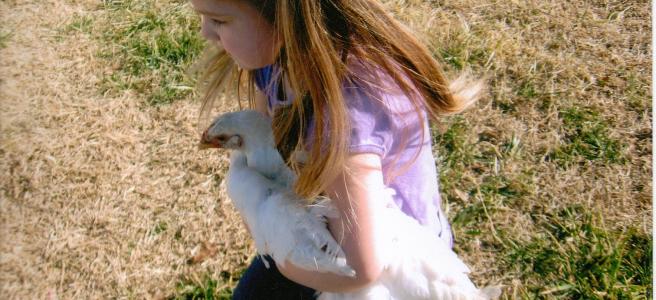
*Photo is from many many years ago, when my oldest child got attached to a runaway chicken.






 And Then There Was Joy